
A remorseful update on Trump’s war in Iran
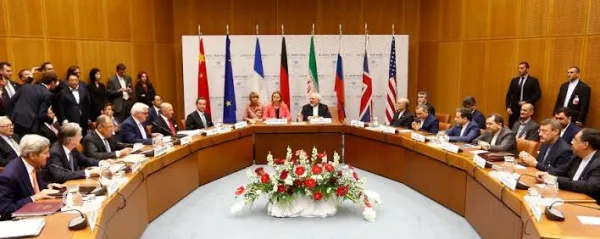
Iran Talks 14 July 2015: Bundesministerium für Europa, Integration und Äusseres, CC BY 2.0 <https://creativecommons.org/licenses/by/2.0>, via Wikimedia Commons
Introduction
Trump set the stage for the war in Iran by withdrawing from an earlier agreement between the US and other states in which Iran allowed robust inspections of suspected sites and agreed, as Iran has consistently done, not to develop a nuclear weapon.
The terms of the agreement
The Arms Control Arms Control Association identifies some of the highlights of the agreement (https://www.armscontrol.org/factsheet/joint-comprehensive-plan-action-jcpoa-glance).
“The nuclear deal between Iran and the multilateral group of states known as the P5+1 (China, France, Germany, Russia, the United Kingdom, and the United States) was endorsed by UN Security Council Resolution 2231 on July 20, 2015.
Iran’s compliance with the nuclear-related provisions of the deal, known as the Joint Comprehensive Plan of Action (JCPOA), is verified by the International Atomic Energy Agency (IAEA) according to certain requirements set forth in the agreement.
- July 14, 2015, Finalization Day: conclusion of the negotiations on the agreement. Finalization day triggers Iran and the United States to begin domestic review processes of the JCPOA. Iran also begins providing the IAEA with information necessary for the agency to complete its investigation into past activities related to nuclear weapons development.
- October 18, 2015, Adoption Day: 90 days after the passage of the UN Security Council Resolution endorsing the deal (July 20, 2015). Adoption day triggers Iran and the P5+1 to take steps (outlined below) to meet the commitments to fully implement the JCPOA.
- January 16, 2016, Implementation Day: the IAEA certifies that Iran has taken the key steps to restrict its nuclear program and has put in place increased monitoring. The IAEA's report on implementation day triggers U.S., EU, and UN sanctions relief. The duration of the nuclear commitments begins on implementation day (for example 15 year commitments expire Jan. 16, 2031.)
- October 18, 2023, Transition Day: Eight years after adoption day (or the IAEA reaching its broader conclusion on Iran's nuclear program, whichever is sooner). Transition day triggers the UN to lift missile restrictions, Iran to seek ratification of its additional protocol, the EU to terminate all remaining nuclear sanctions, United States to remove certain entities from the sanctioned list, and the United States to seek legislative termination of certain sanctions.
The U.S. Congress never formally approved the JCPOA, but they also never passed a bill to block the deal. Iranian assets frozen under a variety of previous sanctions were released. The U.S. delivered about 1.7 billion in cash to Iran, representing money that Iran had paid the U.S. before the 1979 Iranian revolution for military equipment that was never delivered.
Trump withdraws the U.S. from an Iran nuclear deal and gives him an excuse for the later attacks on that country.
Amy Sherman, Jon Greenberg, John Kruzel report on this ill-considered decision during Trump’s first presidential term, in early May 2018
(https://politifact.com/article/2018/may/08/trump-withdrew-us-iran-nuclear-deal-heres-what-you).
On May 8, 2018, Trump delivered a statement announcing, “the United States would exit a nuclear pact with Iran and re-impose sanctions on Tehran, saying the Obama-era deal failed to contain the regime’s nuclear ambitions and regional meddling.” Trump did this without any evidence that Iran was creating a nuclear weapon, the key provision of the agreement.
Sherman and his colleagues offer additional information on Trump’s decision to abandon the deal. They write,
“Trump believed the deal should have allowed international weapons inspectors to have greater access to Iranian military sites. He’s also hammered the deal for not covering Iran’s missile program and repeatedly underscored the need to stop the country from developing an intercontinental ballistic missile.
“Finally, Trump criticized the deal for failing to rein in Iran’s support of sectarian violence in places like Syria and Yemen, despite the deal’s promise to contribute to ‘regional and international peace and security.’”
“A last-ditch effort by leaders of France, Germany and the United Kingdom to address Trump’s concerns failed to persuade him to remain in the deal.”
Was Iran in compliance on nuclear weapons development?
Sherman and his colleagues found “that Iran had largely complied with the deal, and many experts praised the pact for keeping nuclear weapons out of the hands of Tehran.
They add: “Over the 28 months the deal has been in effect, the International Atomic Energy Agency, the foremost authority on the matter, said it found Iran committed no violations — aside from some minor infractions that were rectified.”
What is the practical impact of Trump’s decision?
The White House renewed sanctions targeted “critical sectors of Iran’s economy,” including its energy, petrochemical, and financial sectors.
“Prior to the deal, American and international sanctions shackled the regime. From 2012-15, the Iranian economy shrank by 9 percent per year, oil exports fell by more than half and more than $120 billion held in overseas banks were frozen.
“The lifting of sanctions had roughly the opposite effect. It spurred around 7 percent growth over the past two years, returned oil exports to nearly pre-sanctions levels and unfroze the country’s foreign assets.”
In response to Trump’s decision, former President Barack Obama defended the Iranian agreement and “called Trump’s announcement a ‘misguided’ decision that ‘risks eroding America’s credibility’ and warned that walking away from the deal could make conflict more likely.
“‘If the constraints on Iran’s nuclear program under the JCPOA are lost,’ Obama wrote, ‘we could be hastening the day when we are faced with the choice between living with that threat or going to war to prevent it.’”
Trump’s war is unlawful,
Trump launched the war with huge bombing attacks without consulting Congress or considering the UN Charter’s views on what makes a war lawful. The Charter says this:
“The United Nations was established in 1945 to prevent war and promote peace, human rights, and social progress. Its Charter emphasizes that all member states must settle disputes by peaceful means and refrain from the threat or use of force against the territorial integrity or political independence of any state, except in cases of self-defense or when acting under Security Council authorization (UN Charter Articles 1 and 2.”
Experts agree that, from the onset, the US war on Iran constituted a war crime”
JAMEY KEATEN considers that UN-backed experts cite possible US war crimes in Iranian strikes, AP, Sept 17, 2026 (https://apnews.com/article/un-human-rights-us-iran) …. Keaten is the chief Associated Press reporter in Geneva, focusing on Switzerland, diplomacy and U.N. institutions.
Here’s some of what Keaton reports.
“Experts commissioned by the U.N.’s top human rights body say they have found ‘reasonable grounds’ to believe the United States committed war crimes in two strikes in Iran, including on a school in the southern city of Minab.
“They also accuse Iran’s theocratic government of carrying out crimes against humanity against its own people, in a report published Thursday.
“The report, while not binding, adds to international evidence gathered about crimes in the war in Iran, and could eventually be used in efforts to reach justice in international courts.”
Keaton continues. “The fact-finding mission on Iran, chaired by jurist Sara Hossain of Bangladesh, is made up of independent experts and was created in 2022 by the Human Rights Council, the U.N.’s top human rights body, which is based in Geneva.
“The experts were expected to present their findings on Monday to the council, which is made up of 47 U.N.- member countries.”
In anticipation of the report, the White House’s spokesperson Anna Kelly rejected the report in advance saying the human rights body has “accomplished nothing for human rights while spouting unserious nonsense for decades.”
The UN experts report that the US launched “indiscriminate” attacks on Iran that constitute war crimes on Feb. 28 with special attention to “a pair of U.S. airstrikes that killed at least 178 civilians, including women and children.”
Keaton points out, “At the start of the U.S.-Israeli war against Iran in February, at least one U.S. missile hit the Shajareh Tayyebeh school in Minab, according to an Associated Press investigation.” Iranian state media have said 168 people were killed in the strike, most of them children.
The UN experts “found reasonable grounds to believe the United States committed the war crime of launching indiscriminate attacks resulting in the loss of life or injury to civilians or damage to civilian objects,” a U.N. statement about the team’s findings said about the Feb. 28 attacks by the U.S. and Israel.
“The U.N.-backed team based its allegations on two strikes — one involving Tomahawk missiles that hit the ‘clearly identifiable’ school, and another in which Precision Strike Missiles dispersed tungsten pellets over a ‘clearly identifiable sports complex and residential area’ in the southern city of Lamerd, also on Feb. 28.”
The UN experts also cite “crimes against humanity’” by Iran’s government. Keaton continues. “The team found that killings by state security forces in Iran have occurred on a ‘staggering scale,’ and civilians faced ‘gross human rights violations and crimes against humanity committed by their own government.’”
Both the US and Iran should provide reparations, they say
The experts said the United States and Iran should halt all rights violations and crimes and provide “full reparations to victims.”
The U.S. House has tried to limit Trump’s power to attack Iran
Caitlin Yilek reports for CBS News, Sept. 16, 2026, on how the U.S. House has voted three times to limit Trump's power to strike Iran (https://www.cbsnews.com/news/house-approves-limiting trump-on-iron-for-third time). Here’s some of what she writes.
“For the third time, the House voted Tuesday [Sept. 15] to block President Trump from taking further military action against Iran, with seven Republicans breaking with the president.
“The vote ended in a 220 to 204 tally, marking a symbolic rebuke of the president over the largely unpopular war.
“Tuesday's resolution drew more GOP support than the previous two efforts to limit Mr. Trump's war powers in June and July.
Yilek continues. “Three new Republicans voted yes: Rep. Nancy Mace of South Carolina and Reps. Mariannette Miller-Meeks and Zach Nunn of Iowa. The four who supported the prior resolutions were Reps. Tom Barrett of Michigan, Brian Fitzpatrick of Pennsylvania, Warren Davidson of Ohio and Thomas Massie of Kentucky.
“Nunn, who is in a competitive reelection bid, said in a post after the vote that he will ‘not support another open-ended war.’"
“Miller-Meeks, another vulnerable Republican, added Wednesday, ‘The President needs to present a plan to Congress and the American people for how this end so we can focus on bringing our soldiers home and lowering prices.’"
“A war powers resolution that cleared the House in July has yet to see any movement in the Senate. Both chambers adopted another resolution in June, though the White House has argued against its validity.
“The resolution, introduced by Democratic Rep. Seth Moulton of Massachusetts, directs the president "to remove United States Armed Forces from hostilities with Iran."
Yilek points out that after six months of the war, “the Trump administration has yet to lay out an exit strategy as it seeks tens of billions in additional funding for the conflict that Mr. Trump initially predicted would last four to five weeks. The Pentagon has said Operation Epic Fury — the military's term for the initial strikes against Iran — ended in May, but the U.S. and Iran have continued to exchange fire for months, and a ceasefire intended to bring the war to an end fell apart in July. Oil shipments from the region are still constrained, keeping global energy prices high.”
Meanwhile, Yilek writes, “Republicans are trying to provide up to $73 billion in new funding for the war through the party-line reconciliation process. The House adopted a budget blueprint in July to initiate the process, but it stalled in the Senate over the inclusion of funding for Mr. Trump's voting regulations bill known as the SAVE America Act.”
The war is costly. “The nonpartisan Congressional Budget Office released an analysis Tuesday that estimated the war with Iran could cost approximately $2 billion to $3 billion per month for as long as it continues. Between Feb. 28 and Aug. 1, the war is estimated to have directly cost the U.S. about $38 billion.” Other estimates indicate the cost to be over $44 billion by September. Trump started this war with no idea of how long it would last, how much it would cost, and the inflationary effects on American consumers.
In short, Trump falsely believed it would be an easy war to win, and that Iranian citizens would rise and transform their oppressive government. The number of Iranian casualties did not matter to him. He expected there would be few if any American casualties. He gave little thought to the costs of the war or its domestic economic effects.
The relevance of the Strait of Hormuz was absent in his war impulses.
The cost of the war
Dave Jamieson reports on the financial cost of the war for MSN, Sept 17, 2026
(https://www.msn.com/news/other/iran-war-has-cost-pentagon-436-billion-politics) ….
Jamieson writes, “President Donald Trump’s war in Iran has cost the Pentagon at least $43.6 billion so far, according to a Defense Department assessment obtained by Politico.
“That estimate comes in several billion dollars higher than a different one released this week by the Congressional Budget Office, which pegged the tab at $38 billion.
The CBO estimates that price of the war going forward to be anywhere from $2 to $3 billion a month, depending on whether fighting flares up or dies down.
The CBO estimates “only cover direct military costs from fighting. They do not include indirect costs that U.S. families bear in the form of higher fuel prices. Researchers at Brown University estimate those to be roughly $110 billion and counting.” Gas prices have soared, along with prices for a host of essentials.
Ecocide in Iran
Ashley Gate reports on the environmental effects of the war for The Intercept, Aug 31, 2026 (https://2026/08/31/iran-war-environmental-toxic-chemical-exposure).
Gate’s main point: “The U.S.–Israeli war has caused massive environmental devastation, adding to the long history of American wars with toxic legacies.”
Trump started the war, claiming falsely that it would take less than two weeks to end it on US terms and that it would bring “PEACE THROUGHOUT THE MIDDLE EAST AND, INDEED, THE WORLD!” But after more than six months and two failed ceasefires later, the floundering conflict sputters along. And you may have noticed that world peace has yet to be announced.
Gates continues. “Trump’s other stated war aims, like Iran’s unconditional surrender and seizing its oil infrastructure, have also fallen by the wayside. In the end, the major accomplishments of Trump’s war seem to be limited to death and destruction: hundreds of U.S. casualties that the Pentagon has sought to downplay and cover-up, and thousands of Iranian deaths that the Pentagon is loath to mention or investigate, including a family of eight — five of them children, one a 20-day-old infant.
“But the almost 40,000 Iranians killed or wounded in the war may only scratch the surface of the true toll.”
Gates writes, “The rough outlines of the ecological devastation are only just coming to light. And if history is any guide, the environmental fallout of the war may reach far into the future, affecting untold numbers of Iranians who survived the conflict and many others in generations to come.
The Toxic Inheritance of America’s Wars
Gates continues. “Esmaeil Baqaei, the spokesperson for Iran’s Foreign Ministry, recently warned of the increasing environmental damage caused by the U.S. war, drawing attention to oil contamination in the Persian Gulf that has begun washing up on Iranian shores.
“This incident is only one visible example of the extensive pollution — both overt and concealed — that has degraded the waters of the Persian Gulf and the Sea of Oman,” he wrote on X. “Who bears responsibility for compensating these damages? Is it the nations that consume the inexpensive energy exported from our region, the shipping insurers, or the aggressors and their partners who have transformed the Persian Gulf and the Sea of Oman into a theater for military operations and the testing of highly destructive weaponry?”
“Alongside death and destruction that has killed or wounded tens of thousands of Iranians, the U.S.–Israeli war has caused massive environmental devastation. By March, attacks had already resulted in more than 300 incidents of potential environmental harm, documented across 12 countries in the region, according to a report by the Conflict and Environment Observatory. These toxic exposures threaten not only today’s war victims, but also future generations who will grapple with the knock-on effects.”
Additional facts.
“According to research by the Climate and Community Institute, U.S. and Israeli attacks on Iran in the first 14 days of the war emitted roughly 5 million metric cubic tons of greenhouse gases. Put another way: In two weeks, coalition strikes produced roughly the same amount of carbon emissions as the country of Iceland does over the course of a year. And as the war dragged on, missile facilities, weapons depots, oil infrastructure, nuclear facilities, dual-use and civilian infrastructure including power stations and desalination plants were also increasingly struck.
The catastrophic effects to come
“The environmental threats these targets pose is enormous. Damaged desalination plants jeopardize the civilian water supply and flood nearby land and marine environments with harmful chemicals like sulfuric acid. Bombed infrastructure fills urban streets with asbestos-contaminated rubble and dust, heightening the risk of respiratory illness and cancer among exposed populations. Damaged weapons facilities pollute surrounding areas with explosives, highly toxic liquid propellants, and heavy metals. And the targeting of nuclear facilities risks radiation exposure or worse, an uncontrolled nuclear disaster, like a meltdown.
“Fossil fuel infrastructure has also remained a key military objective for all belligerents. Israeli strikes on more than two dozen Iranian oil depots in early March engulfed the capital city of Tehran in a cloud of toxic smoke that rained black carbon and sulfuric acid on the city’s 9 million residents. Attacks on oil tankers and other commercial vessels have leached oil and spilled fuel into myriad waterways from the Egyptian port of Damietta, where Iran struck two liquefied natural gas vessels, to the coast of Sri Lanka, where the U.S. sank an Iranian frigate. And such environmental damage is likely to increase as the conflict continues to sporadically flare up.”
US troops have been victims
“And for decades, U.S. troops have paid for it with exposures to toxic substances, including defoliants like Agent Orange, an herbicide the U.S. sprayed across Southeast Asia in the 1960s and 1970s; smoke from oil depot fires that dotted the landscape in and around Iraq during the 1991 Gulf War; and the military base burn pits of the post-9/11 forever wars. The PACT Act of 2022 extended healthcare access to millions of veterans who served from the last half of the 20th century to today and now suffer from a wide range of conditions related to such wartime exposures, including cancer, chronic obstructive pulmonary disease, and reproductive issues likely caused or exacerbated by their military service.”
Higher prices in US from the War drives Trump’s popularity down
Dave Jamieson reports on this for MSN on Sept 10, 2026
President Donald Trump’s war of choice in Iran has cost U.S. consumers at least $100 billion in added fuel expenses since Feb. 28, according to Brown University’s Climate Solutions Lab.
“Researchers estimate that the war has created an additional burden of $55 billion due to higher gasoline prices and $45 billion due to higher diesel prices as of Labor Day. They arrive at that figure by setting actual prices this year against estimates of what prices would have been without the war-induced surge in oil prices, then multiplying it by expected fuel usage.
“The tab translates to an average hit of $750 per household, though families with multiple cars and long commutes would bear more.
“‘Energy price shocks function as an economy-wide, unacknowledged tax on American households, with costs comparable to large federal programs and policies,’ the group said in a statement Tuesday.
“Oil prices have shot up since the U.S. and Israel launched their war and Iran choked off the Strait of Hormuz, a vital shipping way that carries about a quarter of the world’s oil supply. Prices have dropped at times only to bounce back up, just as they did on Tuesday, nearing $100 per barrel again due to the standoff in the strait.
“The price of gasoline was below $3 per gallon on average before the war and now hovers at $4.15 as of Tuesday, according to AAA. The higher prices at the pump have helped drive public support for the war to just 31% and Trump’s approval rating to a mere 33%, according to a recent Reuters/Ipsos survey.
“Though less visible than the price of gasoline, the higher cost of diesel fuel has also squeezed Americans’ wallets since the war began. Diesel fuel is used in large trucks, farm machinery and power generation, so households ‘bear these increases through higher prices from their grocery stores, utility bills, and across the economy,’ the Brown researchers noted.
US troops killed and wounded in the region
“On top of the financial cost, the war has led to 18 service member deaths and roughly 800 wounded. Trump recently downplayed those losses by comparing them to the much larger toll of the Vietnam War.
“I’ll tell you what, a lot of people don’t call it a war,” Trump said of the fighting in Iran.“I call it a military conflict because it’s small potatoes for us. It’s not a big thing. We did Venezuela, and we did this. In Venezuela, we lost nobody, and this we lost 18 people. In Vietnam, you lost a hundred thousand people, and in other conflicts you lost tens of thousands of people.”
“It certainly doesn’t feel like small potatoes, Mr. President,” replied ABC News’ Rachel Scott. “Eighteen people have died in this.”
Trump’s popularity has plummeted
This in part reflects Iran’s closure of the Strait of Hormuz and the resultant rise in prices for gasoline and many other items vital to the life of the majority of Americans. Prices began to rise before the War because of Trump’s imposition of tariffs on countries. His popularity has suffered. Fernando Cervantes Jr. presents the results of a recent poll on Trump (https://www.usatoday.com/story/news/politics/2026/09/08/trump-approval-rating-poll/916625007). Here’s some of what he reports.
“President Donald Trump's approval rating fell to a new low of 32% in a Focaldata/Financial Times poll released over Labor Day weekend, reflecting declines among both the general public and Republicans as midterm elections approach.”
“The president’s continued struggles in the polls come ahead of a vital midterm season as his party seeks to hold slim majorities in both the House of Representatives and the Senate.”
Given all the bad news, would a desperate Trump authorize the use of nuclear weapons on Iran?
The Peril of Trump’s Final Act: Would He Use a Tactical Nuclear Weapon in Iran?
Robert L. Borosage considers this question in The Nation, Sept 18, 2026
(https://www.thenation.com/article/world/trump-iran-war-tactical-nuclear-weapon).
He is a leading progressive writer and activist.
Here’s some of his reply.
“Donald Trump is trapped: His war of choice against Iran is lost, an abject strategic catastrophe. Now Trump has to choose sustain another forever war until Iran breaks, a strategy his own generals oppose, or produce a grand finale to get out without admitting defeat. And there is the rub.
“Reality has shattered Trump’s conceits. Instead of a few days, the war has lasted six months and counting. Instead of regime change and popular uprising, the Iranian regime stands with new hardened leadership. Instead of another display of US military prowess, the US military has been driven out of major bases across the region, stockpiles of vital offensive and defensive missiles have been depleted, and
the US Navy has been overstretched and exhausted.
“And Iran keeps ratcheting up the pressure. It controls the Strait of Hormuz, and its Houthi allies have just seized control of the alternative route through the Bab el-Mandeb Strait and blown-up Saudi Arabia’s key east-west pipeline. Crude oil is now over $110 per barrel and rising; the price of diesel—the fuel of commerce—is at record levels. The cost of fertilizer, fuel, and virtually anything that requires transport is going up, with the global economy at risk.
Borosage continues. “In response, Trump grows ever more delusional. ‘The failing Nation of Iran,’ he claims, ‘wants to make a deal, quickly and badly.’ He suggests that Iran is waiting until after our midterm elections to sue for peace, at which point the price of gasoline will ‘drop like a rock.’ Then he muses that we might just stay in Iran:
‘We’ll ultimately get out, unless we decide to stay and keep the oil like Venezuela.’ He turned to Oman as a mediator on reopening the Strait of Hormuz and then threatened that if it ‘gets in the way, we’ll bomb the shit out of them.’
“He dismisses the war as ‘small potatoes,’ claims full control of the Strait, suggests that the ‘Countries of the World…should and will reimburse the United States of America when this SCAM Confligration [sic] is over,’ and jokes that he might rename the Strait ‘Trump Strait,’ saying, ‘I should get something out of it.’
Trump has no good options
“The real straits of Trump are dire: He is trapped in a war that has already been lost, a reality that he will never allow himself to admit. Under Republican control, the House has voted repeatedly to end the war. With Democrats likely to take the majority in the midterms, Trump faces the prospect minimally of investigative hearings that will bare the true extent of the losses, costs, and internal military opposition to his folly. He has to find a way to declare victory and get out, and soon.
“Many experts report that the United States and Israel are gearing up to launch another full-scale operation, probably just after the US midterms. The Trump administration has just approved a $2.8 billion Israeli arms package that includes 40,000 bombs, half of which are 2,000-pound bombs. Even so, skeptics question how much a new bombing wave could achieve, given the depletion of US weapons stocks, naval power, and base support, without the use of nuclear weapons.”
“…Hegseth’s Pentagon has been moving to integrate tactical nuclear weapons into conventional war strategy. The aim, as Under Secretary of Defense Elbridge Colby put it in the chilling language of the megadeath intellectuals, is to provide ‘credible, rational nuclear options that a President of the United States adopting the simple principle of being a normal human being with common sense would actually implement.’”
Trump’s recklessness and mental instability
“The United States, the only country ever to drop a nuclear weapon, has repeatedly refused to adopt a “no first use” policy. The president has sole authority to order the use of a tactical nuclear weapon. Neither Congress nor the public would be given prior notice. Would Trump use a tactical nuclear weapon on relatively isolated Pickaxe Mountain in Iran as his exit line?
“According to the Bulletin of the Atomic Scientists, using a nuclear weapon against a non-nuclear nation is a violation of international customary law. But Trump, as his noxious deputy chief of staff, Stephen Miller, infamously asserted, dismisses international law and treaties as ‘international niceties,’ arguing that ‘the real world…is governed by strength, by force…by power.’ Trump boasts that the only limit on his international power is’one thing. My own morality. My own mind. It’s the only thing that can stop me.’”
Borosage continues. “Dropping a nuclear weapon on Iran would not only be criminal; it would be incredibly dumb. Iran would respond by unleashing an assault on oil and desalination and energy platforms across the Emirates and an unprecedented assault on Israel.
“It would also set off a race for nuclear weapons, as countries across the globe would understand that the reason Iran was targeted and not North Korea is that the latter has nuclear weapons and the former does not.”
“Use of a tactical nuclear weapon would set a precedent for Russia or China to invoke if they chose to use or threaten the use of nuclear weapons against Ukraine or Taiwan or other adversaries. It would put the nuclear arms race, already gaining dangerous momentum, into hyperdrive. And it would indelibly brand the US as a dangerous, pariah nation, feared but despised across the globe.
“For these and other reasons, it is hard to imagine any president making that decision. But Trump, trapped, desperate, angry, delusional, intent on punishing his enemies and displaying his prowess, could well be tempted. And the anticipated Democratic election victories this fall will corner him—and that will make him even more dangerous, as we saw with the sacking of the Capitol after his 2020 loss in the presidential race.”
Borosage concludes. “The last weeks of reduced military activity and apparent stalemate have been misleading. The economic costs of the war—now with oil transport through both Hormuz and the Red Sea constricted—are escalating. The pressure on Trump to escalate, to unleash another round of bombing in order to declare victory and get out, is rising. Without a concerted movement toward a settlement, the unimaginable is becoming more conceivable.
Concluding thoughts
Trump has shown time and again how reckless, stupid, and narcissistic he is. A growing majority of Americans have also come to such conclusions. At the same time, he still had the power of the presidency. He is currently trying to rig elections in favor of Republicans to avoid any challenge to himself by Democrats. He spends much time thinking about how to put his name on monuments and ballrooms and other public places. He is still committed to waging the Iran War and adhering to his belief that the US military will ultimately open the Strait of Hormuz and end the war in favor of the US. Currently, it all sounds like bluster. But if there is no agreement with Iran to end the war, there is a concern that he could order the use of nuclear weapons in the Iran War. We can only hope that in such an eventuality, military officers will disobey.